How AI can enhance productivity in Agile coaching workflows
Issam Gharios, Founder & CEO, Coach Sensai
Karen Donoghue, Principal, HumanLogic
INTRODUCTION
This white paper examines how AI-powered workflow automation is reshaping Agile coaching, drawing on broader patterns in technology adoption and productivity gains to identify both opportunities and risks for organizations implementing these tools.
INSIGHTS FOR AGILE LEADERS
1. AI's role in Agile coaching mirrors earlier automation waves - but this time, human judgment remains central.
Looking at how artificial intelligence has evolved reveals patterns that matter for Agile practitioners today. Consider the progression:
AI in the 1960s: Symbolic reasoning systems tackled constrained problem-solving (like chess and theorem proving) - paralleling how early project management used mathematical models to optimize schedules and resource allocation.
AI in the 1980s: Expert systems codified specialist knowledge to automate decisions where human expertise was scarce - similar to how process templates attempted to capture and replicate effective Agile practices.
AI in the 1990s-2000s: Collaborative filtering learned from behavioral patterns to personalize recommendations, mirroring how retrospectives aggregate team experiences to continuously refine workflows.
Understanding this history matters because each wave brought efficiency gains alongside unintended consequences. Early project management automation often ignored the human dynamics that determine whether teams actually deliver. Template-based Agile implementations frequently became rigid processes that contradicted Agile's adaptive principles.
Today's AI systems can analyze standup notes, identify blockers across sprints, and surface patterns in team velocity - but they work best when they augment rather than replace the Agile coach's capacity for nuanced judgment. A system like Coach Sensai helps identify impediments and handles the mechanical work of tracking them and generating health reports, freeing coaches to focus on the interpersonal dynamics and strategic decisions that determine team success.
The goal is not to automate coaching but to liberate coaches from administrative overhead that dilutes their impact. Eliminating administrative burden enables Agile coaches to focus on facilitating collaboration, resolving conflicts, and developing teams’ problem-solving capabilities, while being better informed about where attention is needed most.
2. The productivity challenge in Agile coaching isn't about presence - it's about where coaches direct their attention.
Many organizations struggle with a fundamental misallocation of coaching time. Agile coaches and scrum masters spend hours manually updating boards and tickets, consolidating metrics from multiple tools, preparing reports for stakeholders, and tracking down status updates that should be readily available.
This mirrors a broader pattern in knowledge work: leaders fixate on visible activity rather than meaningful outcomes. In Agile coaching, the question isn't whether coaches attend ceremonies or work alongside teams in person, but whether they're spending their time on these capabilities that drive coaching effectiveness:
Measure impact, not activity. Track whether teams are improving their collaboration patterns, reducing cycle time, or increasing psychological safety, not whether every ceremony happened on schedule. AI can automatically surface these outcome metrics.
Encourage teams to develop their own agreements. Use coaching time to help teams design their own working protocols rather than imposing standardized processes. AI can monitor adherence to whatever agreements teams create, freeing coaches from compliance monitoring. While conducting more than twenty user interviews with Agile coaches, scrum masters, and team members, we heard repeatedly that they do not want to “police” teams’ activities, but rather want to improve team productivity and performance.
The offloading of administrative overhead and surfacing of outcome-focused insights automatically by Coach Sensai frees agile coaches to invest their time where it creates real leverage: guiding teams to define their own working agreements, developing deeper coaching craft, and driving meaningful improvements in performance and team dynamics.
3. AI-enabled coaching creates new challenges around decision-making quality and human judgment.
As AI takes on more Agile workflow tasks, leaders should monitor three developments that could undermine coaching effectiveness:
Whether AI improves or obscures team health assessment. Can language models aggregate signals from Teams or Slack conversations, commit patterns, and retrospective notes more effectively than human coaches who know the team's history and context? Early research suggests AI excels at identifying surface patterns but struggles with the deeper reasoning required to understand why a team is struggling. Coaches should test whether AI-generated insights actually improve their ability to intervene effectively or simply create more noise.
The risk of homogenized coaching approaches. When multiple coaches rely on identical AI-generated sprint health reports, does the diversity of coaching perspectives that leads to better team outcomes disappear? If every coach receives the same analysis of a team's velocity trends, they may converge on similar interventions even when creative, context-specific approaches would be more effective. Organizations should actively preserve coaching diversity even as they adopt shared AI tools.
How technology changes coaching behavior. Beyond AI analysis, consider what happens if coaches shift from in-person observation to dashboard-based assessment, or when teams move from face-to-face retrospectives to AI-mediated feedback collection. These technological shifts affect both coach effectiveness and team dynamics in ways that require ongoing study.
PRIORITIZING MEANINGFUL WORKFLOWS OVER PURE AUTOMATION
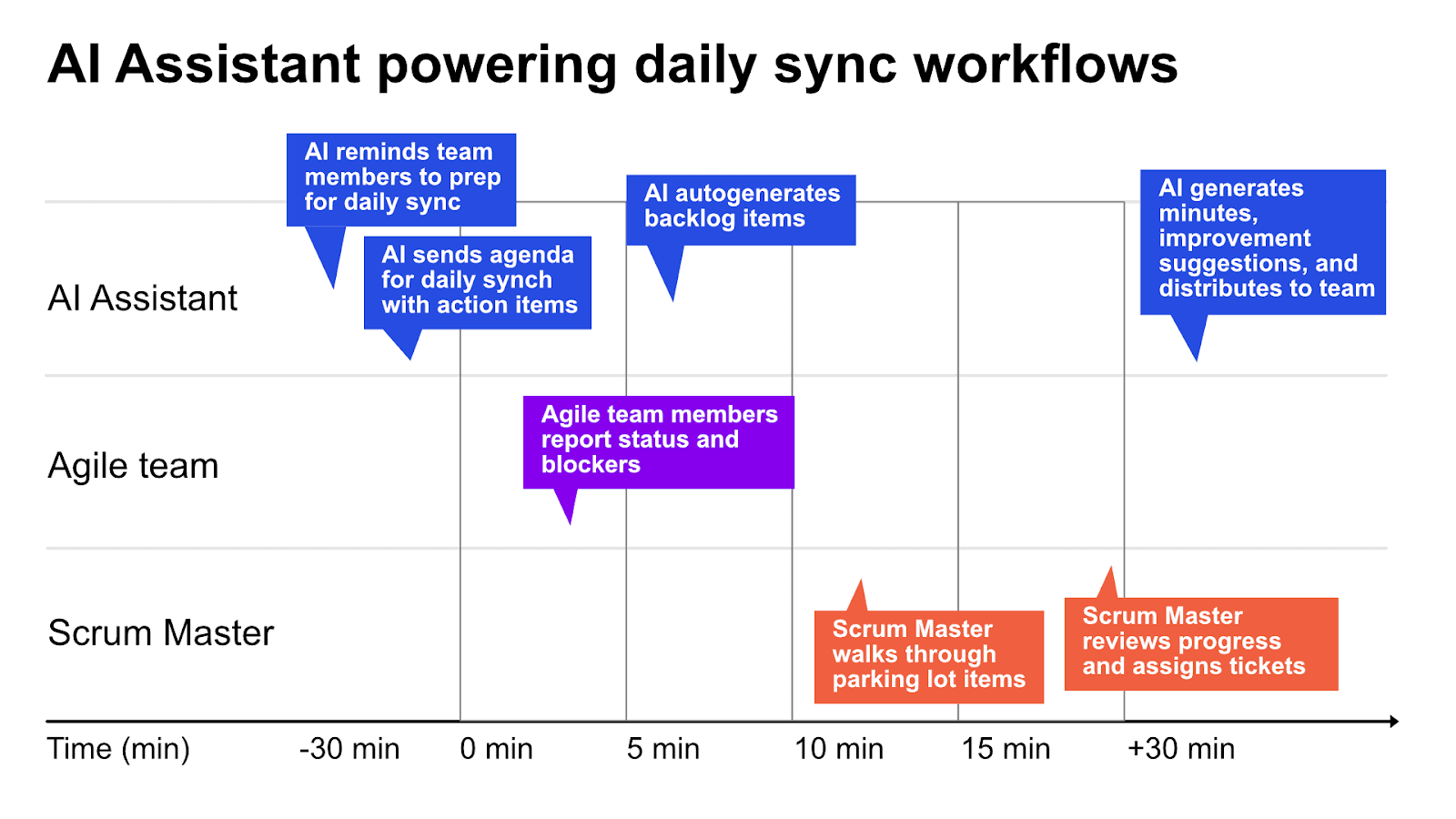
Coach Sensai is prioritizing end-to-end workflow assistance, creating an integrated user experience that meets coaches where and when work actually happens, rather than just a tool used at a single step in the workflow. Operating in situ, Coach Sensai delivers coaching guidance directly within the platforms teams already use - such as Slack and Microsoft Teams. This embedded approach ensures that the agent becomes a natural extension of existing team workflows rather than an additional tool requiring context switching or workflow disruption.
By positioning Coach Sensai within workplace communication tools, we enable coaches to access real-time insights and provide in-the-moment guidance without pulling teams away from their primary work environments. This seamless integration reduces friction and increases the likelihood of sustained engagement with coaching interventions.
As we continue to refine Coach Sensai, we remain focused on a critical design principle: the value of AI assistance lies not merely in task automation, but in whether it genuinely enhances a coach's ability to understand and improve team dynamics. Technology that promises efficiency gains can actually diminish coaching effectiveness if the user interface is poorly designed or the automation is misaligned with the nuanced needs of human development work.
Our approach emphasizes thoughtful integration that augments coaching capabilities while preserving the human insight and relationship-building that remain central to effective team development. We are committed to ensuring that every feature and interaction pattern serves the ultimate goal of better coaching outcomes, not just operational efficiency.
THE PATH FORWARD
AI in Agile coaching works best when it follows a principle that software teams already understand: automation should handle repetitive tasks while humans focus on problems that require judgment, creativity, and interpersonal skills.
For organizations evaluating AI-enabled coaching tools, ask whether the technology truly frees coaches to do more valuable work, or does it simply create new forms of overhead disguised as efficiency gains. The promise of systems like Coach Sensai isn't that they replace human coaches, but that they remove the mechanical barriers that prevent coaches from operating at their highest capability.
The most successful implementations will combine a deep understanding of Agile practices with careful attention to how coaches actually work and by translating AI capabilities into workflows that genuinely enhance, rather than constrain, coaching effectiveness.
AUTHORS
Issam Gharios, Founder & CEO, Coach Sensai
Coach Sensai is an AI-powered platform that streamlines Agile workflow management by automating routine coaching tasks for ceremonies such as standups and retrospectives. With integrations across project and communications management tools, Coach Sensai enables coaches to focus on high-value team development work. For more information, please visit Coach Sensai.
Karen Donoghue, Principal, HumanLogic
HumanLogic is a boutique product design consultancy that transforms complex technical capabilities into intuitive, business-critical user experiences. We partner with organizations to design products where innovation and usability converge to deliver measurable impact. For more information, please visit HumanLogic.
Drive Continuous Improvement in Product Delivery
Operationalize Agile at scale with confidence.