Agile
SCRUM
Issam Gharios
Feb 4, 2026
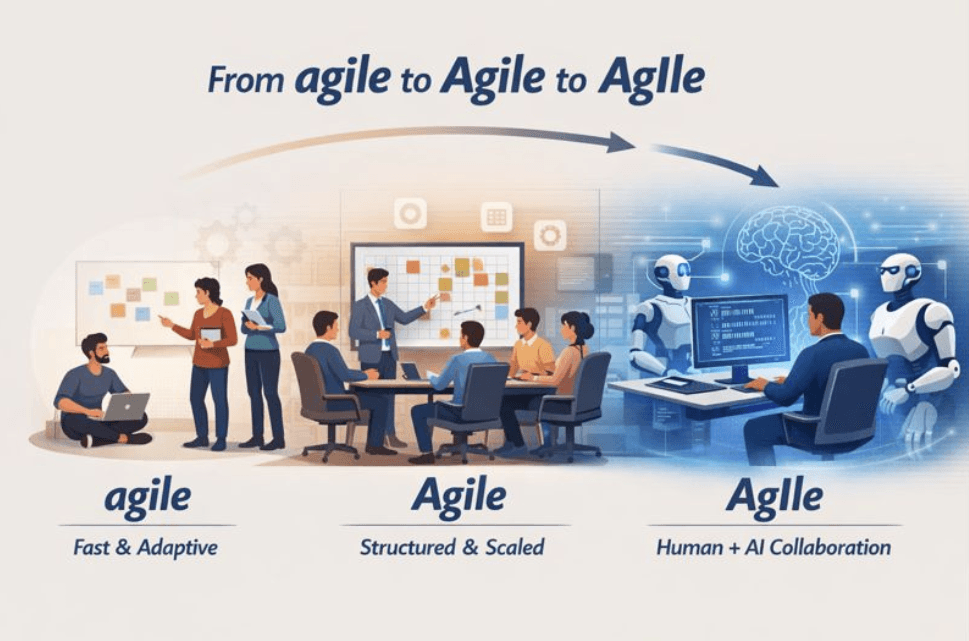
We use the word Agile a lot. So much that it’s easy to forget where it started, and why it’s struggling to keep up with what’s coming next.
agile: the original idea
At its core, agile wasn’t a framework or a ceremony. It was a mindset.
The dictionary definition is simple: quick and well-coordinated in movement. That’s exactly what early agile teams were optimizing for. Moving fast, learning quickly, and adapting when reality changed.
Small teams. Short feedback loops. Shared context.
It was working early on because coordination was manageable.
Agile: the operating model
As software scaled, agile became Agile.
The dictionary definition reflects that shift: a philosophy of modular software development that delivers successive versions of a product, evolving through empirical evaluation.
BUT, through commercialization and consulting, Agile turned into processes, roles, ceremonies, and tooling, all designed to help organizations move faster at scale.
Agile wasn’t about speed for its own sake.
It was about coordination, helping dozens or hundreds of people move in the same direction without collapsing under their own weight.
When done well, Agile reduced waste and increased clarity.
When done poorly, it turned into overhead.
AgIle (Capital ai): the next transition
Now we’re entering the AI era. We must go back to the original definition, “quick and well-coordinated in movement.” and do this for Humans and AI Agents working together.
AI can write code, generate designs, summarize discussions, and move at speeds humans can’t. But speed alone doesn’t equal progress. Uncoordinated speed creates more damage than value. This is why we need the NEW AgIle.
AgIle isn’t Agile with AI sprinkled on top. It’s a shift in how organizations think about scale, coordination, and leverage when part of the system is non-human.
Vibe coding is ONLY 1 piece of the puzzle
Vibe coding is fun. It’s a great hobby. It’s an incredible way to learn.
But it doesn’t scale and it’s not enterprise software development.
The future isn’t a lone developer prompting a few agents and shipping faster. The future is organizations building workflows where humans and AI agents work together, intentionally and predictably, to produce value.
Producing software 10x faster doesn’t come from clever prompts.
It comes from:
Clear intent
Structured workflows
Shared context
Tight feedback loops between humans and machines

The Flash problem
Imagine if the Flash could run incredibly fast — but still perceived the world like a normal human.
He wouldn’t run around obstacles. He’d run through them.
More speed. Same processing model. More damage, not less.
That’s what unstructured AI adoption looks like inside organizations today.
Becoming AgIle
AgIle organizations don’t just move faster. They move with intent.
They invest in workflows that:
Introduce agents deliberately and with purpose
Deliver the right context at the right time
Align humans and agents around shared goals
Reduce coordination cost instead of amplifying it
We’ve been here before. www.CoachSensai.com will help us avoid repeating the same mistakes.